Monday, August 13, 2012

Visiting The Shroud of Turin

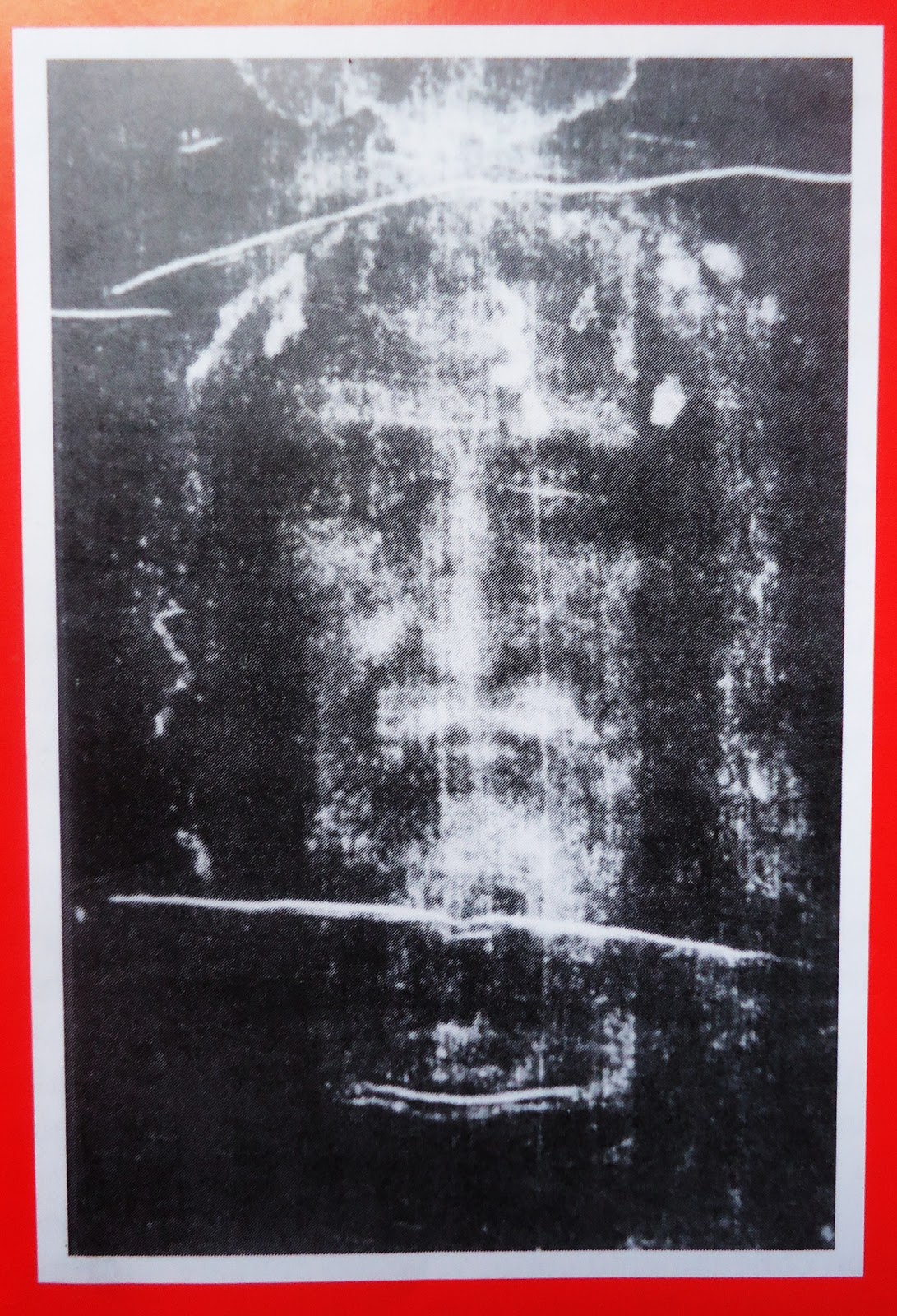
Photo negative of the face of The Shroud of Turin. Photo of image in a pamphlet from The Photographic Display of the Shroud, Sanctuary of the Madonna of the Divine Love, Rome, Italy.
Back in 2010, the famous Shroud of Turin was on display in Turin, Italy. Being a cultural Tour Guide and Tour Accompanier here in Italy, i knew i couldn't miss something like this. So i made preparations with a friend to go from Rome to Turin, in northern Italy, for the display and to study up all the info i could about the Shroud in preparation.

Dr. Joe Nickell's book on the Shroud. He is the
Senior Fellow of the Committee for the
Scientific Investigation of Claims of the
Paranormal.
In this post i will talk about the history of the Shroud, what is known, claimed and believed about it, my experience going to see it, and then i will describe the three possibilities of the true nature of the Shroud.

History and Claims

The Shroud of Turin makes it's first appearance in the history books in the 14th Century, in France. "We do know that by about 1357 the shroud was placed on view by the canons of Lirey. Great crowds of pilgrims thronged to exhibitions of the 'relic,' which was shown at full length and advertised as the 'true Burial Sheet of Christ,'" writes Joe Nickell, Ph.D. in his 1998 book Inquest On the Shroud of Turin: Latest Scientific Findings.

The idea is that after Jesus's, his body was removed from the cross and placed in this shroud, this sheet, and that an image of him remained there on the cloth. This image shows how the Shroud would have been wrapped around Jesus' body:
Photo of image from April 2010 edition of Oggi magazine.
Many Catholics and Christians around the world venerate this Shroud as a holy relic. Both at that time and this one though, even Catholic authorities are of mixed opinion on the authenticity of the Shroud. The Archdioceses of Lirey, France, at that time in the 14th Century obviously endorsed this. (Nickell, p. 11)  French Cardinal cum anti-Pope Clement VII claimed that the image on the Shroud was a "representation" and that it was therefore not a relic, not the burial shroud of Jesus. (Nickell, p. 7) (It would take a whole other blog post to explain what an anti-Pope was, but suffice it to say that in his time and place in 14th century France, he was a Catholic authority locally seen as the one true Pope.)
Modified photo of Shroud of Turin,
from Wikimedia Commons

In more modern times, Pope Benedict XVI spoke very vaguely and craftily about the Shroud in such a way that he did not actually say it is an authentic relic, the true Shroud of Jesus, but that allowed people to believe he had done so anyway. Check this out:
"Dismissing skeptics on Sunday when he visited the Shroud of Turin, Pope Benedict XVI said the burial cloth was none other than the same robe that once 'wrapped the remains' of Jesus Christ."  
That's journalist Nick Squire's subheadline in an article in The Christian Science Monitor on May 3rd, 2010. What the Pope actually said is that the Shroud, "wrapped the remains of a crucified man in full correspondence with what the Gospels tell us of Jesus." (the quote is in both that CSM article, and in translation in the Oggi magazine cited above.) He later cites the Pope also saying the shroud is ""an icon written in blood; the blood of a man who was whipped, crowned with thorns, crucified, and injured on his right side."  This is classic politician speak from the Pope. If it is an icon, it is not a relic. He does say it is an icon, but doesn't bother mentioning that it is therefore not a relic. But, the journalists of the world worked their magic on those quotes just the same.

Much more clear though is Archbishop of Turin, Cardinal Giovanni Saldarini at the previous showing of the Shroud in 1998, who "insisted the shroud was not a relic (that is, not a burial cloth) but an icon (an artistic image)." (Nickell, p. 7, citing New York Times, April 19, 1998)

With the opposite view point is STURP, which is meant to stand for Shroud of Turin Research Project. They have in modern times insisted on a fair-minded, scientific study of the Shroud. "I personally believe it is the Shroud of Christ, and I believe this is supported by the scientific evidence so far," (Nickell, p. 115) said one member of the STURP team. And another: "I believe it through the eyes of faith, and as a scientist I have seen evidence that it could be his [Christ's] Shroud." (Nickell, p. 115) THEN, after making these statements, these supposed scientists were granted to permission to have access to the Shroud for what they were calling scientific study.

Waiting in line to see the Shroud of Turin


My visit

The Shroud of Turin on display in Turin Cathedral, 2010
i took a train from Rome to Turin to see the Shroud on display there in Turin Cathedral. i paid the required 4euros to make a timed-reservation online in order to see the Shroud. Then, i got there an hour ahead of my appointment, as prescribed. When i got there, i found a typical Italian mess. Not only was there a line around the block and down the street, and not only was there nothing to do about the fact that i had a timed-appointment, but nobody ever even checked my appointment or confirmed that i had paid for it at all! Noting that the crowd was in fact mostly Italians, very few foreigners, i began to feel that reservation fee had been a bit of a joke or a foreigners' tax, and that i should have realized the Italianess of it and just showed up without the reservation - the waiting in line to view the Shroud would clearly have been exactly the same.

When we finally arrived in the Cathedral, the place was packed. Waiting in this long line got you the right to go up close to the shroud, within maybe 15feet, and remain there close for a few minutes.Then that group was ushered away and a new group of many dozen was ushered in.

The "Prayer of the Shroud" was being recited every few minutes as we shuffled towards the main attraction.

i was surprised by what i saw: The Shroud of Turin is a white sheet with burn holes on it. There is just the vaguest hint of any image at all! The photos that you see of the face, like the one at the top of this blog, are created by creating a photo negative of the image of the Shroud. Or, like the one of the whole Shroud from Wikimedia Commons, they've simply played with the contrast and color saturation of the photo itself.
The Shroud of Turin
The left hand side in the photo here above shows the front of the man, with the feet on the left and the head in the middle. The other side shows the back. As you can see, this is hardly visible.

My zoomed in photo of the face of The Shroud of Turin.

My photo of the Shroud of Turin with the modifications like the ones often used in the famous images of it.
When my friend and i arrived up close, we and everyone around us took out our cameras. There were signs all over saying no flash AND no photography. But there were digital cameras out all over the place. As we got close, an Italian kid in front of us, camera in hand, asked a lady guard if photos were okay. 
"No," the lady said. 
"Without a flash?" the kid persisted. 
"Non si potrebbe," she said, which is something like "No you shouldn't." 
And then that kid and all the rest of us started taking photos! The kid was just inches away from the guard who had just said no, and nobody bothered anybody about it. Gotta love Italy! And, when in Rome!..so to speak.

Three possibilities of the truth

So what is the Shroud really? From what i can tell, there are there possibilities:

Possibility 1. It is the authentic Shroud of Jesus, and the image was created by residue of his actual crucifixion, ie., blood stains.

There are three major problems with this theory:
Cutting the Shroud of Turin?
Image from Great Shroud of Turin FAQ

Problem A. It has been Radio 14 carbon dated to be about 700years old. From a peer-reviewed article in Nature: International Weekly Journal of Science:
"Very small samples from the Shroud of Turin have been dated by accelerator mass spectrometry in laboratories at Arizona, Oxford and Zurich. As controls, three samples whose ages had been determined independently were also dated. The results provide conclusive evidence that the linen of the Shroud of Turin is mediaeval."
But controversy has been stirred over claims that the Shroud had been mended 700years ago and the scientists had managed to only take samples of the mended parts.

Problem B. The facial image on the Shroud is of normal dimensions. But, when an image is created by putting a cloth-like material over a face (such as when making a death mask), the image comes out distorted, too wide. The two-dimensional view of a three-dimensional object is always distorted, as can be seen in this ancient Greek death mask of a Mycenaean king, sometimes thought to be the famous Agamemnon:

"Golden Mask of Agamemnon," Archeological Museum, Athens, Greece
Ironically, the fact that the Shroud face looks correct and life-like actually indicates that it was not created by being faced over the bloody face of anybody.

Problem C. A STURP scientist looked at the fibers of the colored parts of the Shroud under a fancy microscope to find out what caused the color. What did he find? "He had detected significant amounts of artists' vermillion and rose madder" as well as "ultramarine, azurite, orpiment, and wood charcoal - all known in the Middle Ages and suggestive of the shroud's presence at some time in an artist's studio." (Nickell, p. 124)  In English? He found paint. It is paint, said the scientist commissioned by the Shroud of Turin Research Project to consider such questions. Very simple. That scientist, Walter McCrone, was then ostracized from STURP.

Possibility 2: It is the authentic Shroud of Jesus, but the image was created due to the miraculous power or intention of God.

Glowing Jesus? Image from Pope Alice
You can't argue with what someone believes. But i personally can't buy this one, simply because i think it sells short the power of God. Perhaps he made Jesus' body die with an explosion of light, which almost photographically or with vapor left the image of Jesus on the Shroud, or maybe he just inexplicably put the image there with his divine will or divine hand.

If he wanted to make a permenant image, though, i think it would still be there. It just doesn't make sense that the deity would or could fail to make the image last forever, nor does it make sense to me that he would choose to make such an important image and then let it fade away. Even the ancient Greeks could make images that have lasted 3,000 years, i'm sure God himself could have lasted 2,000 without the image becoming a nearly blank sheet!
Remains of 3,000 year old painting from the ruins of Akrotiri, Santorini, Greece.
Photographed in the Archeological Museum, Athens.
Possibility 3. It is not the Shroud of Jesus or of anyone else, it is a 500-700year old painting.

Nevermind the fact that at least one scientist found under a microscope that it was a painting (some people even say Leonardo da Vinci painted it (Gianella, Oggi magazine, April 2010), though that presents its own whole new set of problems). Here is the story that makes me laugh out loud every time i think about it, that makes me sure it is a painting and not a relic:

At the turn of the 16th century, the owners of the Shroud at that time wanted to know whether it was in fact a miraculous image. To test this, they boiled the Shroud and scrubbed it to see if the image would come off -

AND IT DID! (Nickell, p. 107)

Like i said, you can't argue with what people believe, but for me the question became laughable 400years ago when they washed it and turned this remarkable painting into a nearly-blank white sheet!

The Shroud of Turin, nearly blank today.
All photos by the author unless otherwise noted.

i love the foreigners in Rome, especially in August!

Massage from a Chinese lady, on Ostia beach, Rome
i love the foreigners in Rome. We really make the Roman world go round, especially in August.

i live on Piazza Risorgimento, in downtown Rome, just outside of Vatican City. When i go outside in the morning to the bar right on the corner, the first smile and "Buon giorno," i get is from the Romanian girl that makes my coffee.

If i'm missing an ingredient for breakfast, i go around the next corner to the Bangaldeshi mini-mart where the shop keeper gives me a smile and asks how i am. He is almost always open, even late into the evening. Local holidays mean nothing to him, so he's here all August, on Christmas, Easter, whatever. And it's not just because he's not Christian - right now is the month of Ramadan, a serious holy period for Muslims, during which they do not eat from sunrise to after sunset for the whole month. This does not cause him to take time off work, it does not cause him to be any less consistently friendly than he always is.

If i need something printed out from the internet i go across the street to his brother's internet point. He also keeps his shop open late every day and is on his toes to be helpful. (And there are no internet points in this neighborhood run by Italian people, so all the more reason to be thankful for the Bangladeshis!)

August is famous for being the hottest month of the year, and we are told it's a bad time to visit for that reason. But actually July is the hottest month here. And what do all the Italians do in August? They go on vacation in Italy!;-) And because of this things run by Italians, like restaurants and churches, tend to be closed, sometimes without explanation or warning. i found this to be the fact yesterday at the Pantheon, as i took clients there during hours it should have been open...but it was not. Why? Because they don't tend to hire foreigners as staff there, so it has to close in August, screw all the visitors from around the world that have come to see it!

i walked all over the center yesterday and heard barely any Italian being spoken. This makes the sites much less crowded, and the roads are quieter, and much safer, without the Romans driving on them!

Getting a massage on Ostia beach, Rome
And as the Italian restaurants close up, i find myself increasingly thankful for the kebab shops around the touristy parts of the center, where i can good wholesome, tasty food served to me most hours of the day. My favorite shop here is run by a Kurdish guy from Turkey, always open, always friendly.

But maybe my favorite way that foreigners make experience better here is at Ostia beach, where Rome meets the sea. It reminds me a lot of the Jersey shore. Nice, sandy beach, often with nice waves to ride - and African and Bangladeshi guys bringing around water and beer (!!!) for the same price that the Italians sell them for in the bar. And best of all, Chinese ladies giving good, cheap massages on the beach. Most recently i paid 20euros for a 45minute massage from a Chinese lady called Chen. They tend to not speak much Italian or English, but they sure know what they are doing! Chen even got the many-miles-per-day-of-walking out of my feet, the tension from carrying my work bag out of my lower back, she massaged the inside of my eye sockets and the crown chakra at the top of my head. It was pretty fantastic and made me realize how much i appreciate the foreigners in Rome, especially in August! :-)

First photo by my friend Harry O.B., second pic by an unknown friend of the author - anybody want credit? 

Wednesday, August 8, 2012

Poem: Absolutely Anything Is Possible

M.C. Escher's Drawing Hands
Back in high school and college i got interested in spoken word poetry. i had actually forgotten this until recently a beautiful, muse-like woman accidentally lead me to remember it. i found some of my old poems, including this one, with which i made my poetry open mic debut, performing this poem on June 4th, 2002 at Mango's on 14th St. NW in Washington, D.C.

"Absolutely Anything Is Possible"
- by PaxRyan

"Absolutely anything is possible,
Even the unlikely things
     that aren't very probable.

You see, the rhythm of this life is altogether rife
    with surprises.
It's a syncopated mess that won't always give
    what's expected. 

Women with gills and pregnant men,
Happy homework - what would happen then?
World peace and angels with aces,
Pigs that fly and money trees that shed.

Yes, absolutely anything is possible,
Even the unlikely things
     that aren't very probable.

Or are some things for sure?
Death and taxes, constant war?
     Maybe.

Maybe this will be the time 
     that we're all surprised to find 
     that we're wrong.

Because, absolutely anything is possible,

Even the unlikely things

      that aren't very probable."


(Escher image from WikiPaintings.org: Visual Art Encyclopedia.)

Tuesday, August 7, 2012

Greeks on Greek politics

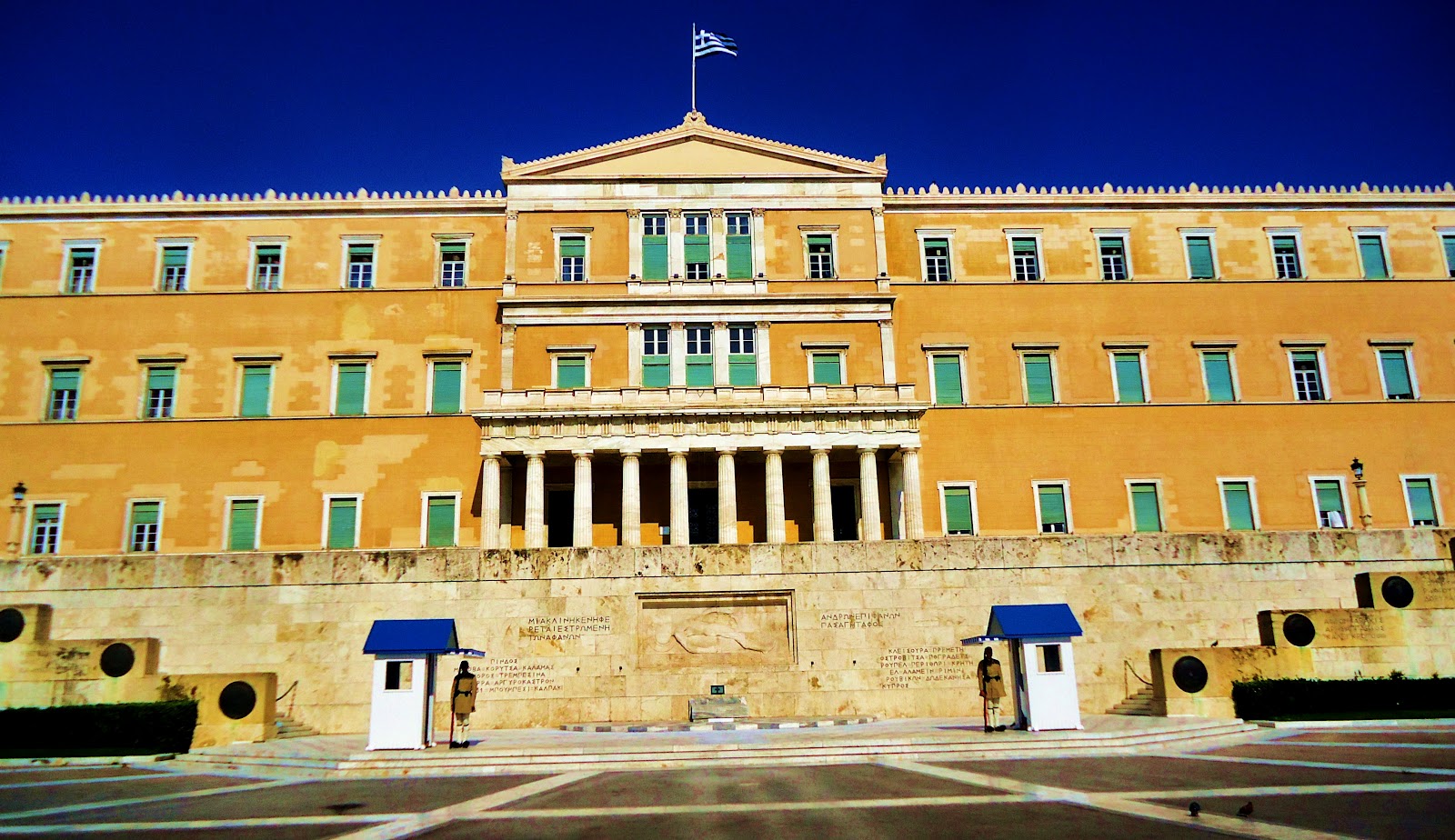
Syntagma Square graffiti, Athens
Back in June i was working on a traveling tour from Rome to Greece. We were to arrive in Greece just days after their 2012 Parliamentary elections. Leading up to the tour some of my friends and colleagues joked that there might not still be a Greece by the time we get there.

This, of course, is ridiculous. All the Greek politicians could disappear and evaporate, all the world's currencies could spontaneously combust, and Greece would still be Greece, with its islands, its olives, is Orthodox traditions and ancient history, etc. Several Greeks pointed this out to me while i was there. Greekness is not political.

The press was billing this election as a competition between pro-Europe forces in Greece that would choose to conform to austerity and stay within the Eurozone and anti-Europe forces that wanted to see Greece exit from the single-monetary zone and therefore maybe from the European Union.

From this perspective, the pro-Europe forces won.

Now, as was my habit also in Egypt and Rome, i asked several local Greek people what they thought of the situation. One reaction was almost universal: they were all glad to have a government. Before these elections they apparently had no governing coalition, so they all seemed glad to no longer be a ship adrift.

Most of the people i talked to about it had little more to say on the situation though, they seemed resigned to apathy (in fact all of the tour-bus drivers i came across had this attitude.) The tour guides though and tourist accompaniers (quite an entrepreneurial group, generally speaking) all said that the result had been a bad one. "It would be better for everyone if we get out (of the Euro zone)," one guide told me, with an undertone of embarrassed humility that went through the rest of the conversation as well. Another guide agreed but took a more sensible, if radical, point of view:

She claimed that the press had misframed the argument as being between pro-Europe and anti-Europe factions. Instead, she said it was a decision between the status quo corruption that had lead them into the mess, and a newer, outside-the-beltway faction (to put it in American terms) that was pushing for a smaller, less corrupt, less Europe-dependent government.

As austerity packages continue to be pushed upon the Greek people, she seems to me to be right. The government is now telling the people of Greece that their pensions, their prescription medicines, the social programming and safety net must all be removed in order to pay their bills. The problem though is that the people did not spend Greece into debt, their politicians did. The Greeks get a lot of government benefits, they also pay quite high taxes. This should work out fine, if the government intended it to be so.

The politicians and their appointees and families have enjoyed spending and wealth at an unsustainable rate. This spending did not make all Greeks wealthy, but it did do so for a small political class. Now the bill for that class's spending is coming due, and they are forcing the same poorer people to foot the bill for their wealth and spending.
Greek Parliament, Syntagma Square, Athens

In Italy, where there is 1/5 the population of the USA, they have a larger number of publicly funded officials than in the States. The situation is similar in Greece. By employing so many citizens in cushy jobs, the incumbent government creates their own voting bloc. They can then screw the majority for the pleasure of the minority - and that is what i see happening in Greece (and in Italy and the USA for that matter.)

It would be different, the guide said, if the bailout money was coming from European banks. But it is not, she said, it is coming from specifically (obviously self-interested) German banks.

Then she made a fascinating point: Back in 2001, why would Germany, even then among the stronger of the European economies, agree enter into the single monetary Euro zone knowing that such weaker and more poorly managed economies such as Greece and Italy were and in fact would become such terrible and dangerous financial partners? The reason, she suggested, was a hunger for power and the knowledge that in fact Greek (among others) politicians were perfectly happy to, even intending to, spend their country into ruin. When the Greek government eventually could not pay their debt, that was Germany's cue to step in and offer to foot the bill in exchange for just that little thing called sovereignty. "This is the 4th Reich," she said. (Not to mistake this for a Nazi reference necessarily, she made it clear that her point was that they were power hungry - she made not indication that it was the same type or motivation of power hunger from the 1930s-40s.)

And that's what it's coming down to now. Germany is (partially already) calling the shots of how Greece should be governed. i personally don't trust banks to save anything, i agree with that first guide i talked to - it would be best for everyone long term if failing governments did not take bailouts from foreign banks! Whatever the people might have to go through as a result, it will still be better than going through exactly the same thing while also being owned by profit-interested banks, which is what is happening now.

"We are not born with critical thinking," this female tour guide pointed out. And, she's right - as Western world's middle class is proving. We are also beginning to learn the consequences of the fact.

All photos by author.

Friday, August 3, 2012

On rude Italians

When i do traveling tours as an Accompanier around Italy, after a few days invariably the clients begin coming to me to ask very hesitantly if the people in Italy are always so rude or if it is just them.

Sadly i have to inform them that that is how it goes here. Italians have a reputation for being very very friendly - and they are, to family, friends, and people that are giving them money. But visitors to Italy often to not encounter any one under those circumstances. Instead these visitors find themselves going into shops and being completely ignored by the staff that works there. It is not at all an uncommon experience to go into a shop (could be souvenirs, clothes, tobacco shop, whatever) shop around, go to the counter to pay, pay, and then leave while the person working there has been on the telephone the whole time, never even interrupting themselves to deal with the customer.

In America, where most of my clients come from, this would be strikingly weird and out of place and everyone would assume, i think, that if the boss or owner were to notice this behavior the employee would be fired on the spot.

i have repeatedly seen these Americans then assume, "The people here obviously don't like Americans, look how rude they are to us!" (And don't even get them started on Paris!) Then i have to explain, "No no, it's not you and it's not Americans, that's just how things go here."

i had a day recently that exemplified Italian rudeness perfectly:

i was going to visit the Borghese Gallery here in Rome. At the ticket office there was just one family ahead of me in line. When they finished their transactions and had their tickets the Italian girl working at the desk got up and walked away leaving me there by myself. She did not say anything or excuse herself, nothing.

When she eventually came back i gave her my reservation codes and she gave me my tickets. "You enter upstairs, right?" She looked at me and lowered her head in what pretty clearly seemed to be a nod (at this point she has yet to open her mouth to me at any point.) So i go upstairs to the entrance i've always used before and find it is roped off and clearly no longer an entrance. So i go back downstairs to the ticket lady and say, "i though the entrance was upstairs, is it not?"

"In the back on the right," is all she said, and with a voice and contenance that made it very clear i was annoying her.

So i go to the back of that downstairs room, turn right and find the new entrance. When i walked up to the ticket checker there she held up one finger and rotated it in a circle. i'm trying to hand her my ticket and she's spinning her finger, not speaking. i have no idea what the hell she could be doing so i use my words. In Italian, exasperated, i ask her what she is doing. "Your bag," she says, and nothing more.

WTF!?!?!?

i literally didn't know what to say. i felt like i'd been transported to a bizzaro world of retarded mutes. Finally she says, "You have to check your bag." i was wearing just my small tour guiding bag that i have carried into museums all over the world without a problem, but whatever.

So i go to check my bag in and find the same experience as at the ticket booth. There are two employees there, a few families in line, and the employees are chatting in Italian while one of them accepts the bags to be checked in and the other one helps him by....chatting and doing nothing else.

Then, the family in front of me is taken care of and both of these cacacazzi turn and walk away continuing their conversation. i'm left standing their by myself while the ferocity of my suppressed rage at the rudeness threatened to boil over.

Annoyingly, since i understand Italian, i know they're just talking about going to the beach this weekend, where to go and who to invite. Which is FINE....but either do the job my ticket price is paying you to do or please go home so that maybe someone else will do the job!!!

When i finally get that taken care of i'm heading to the entrance again and go by the desk where they rent out audio guides. i wanted to hear the house's explanation of their art so i stop to pick up an audio guide. Nearly as taciturn as her colleagues the lady there grabs an audio guide when i ask for one. The cost was  6euros and i handed her my Visa card, figuring that since this is a famous museum at which i had paid for my tickets by credit card, they must accept credit card.

"No card," the girl says, startling me with the sudden burst of speech.

So i reach into my pocket and wallet and find that due to poor planning, i have just 4euros on me. i couldn't believe how this visit was going. "In fact, i cannot take the guide, i do not have 6euros in cash right now," i told her and walked away quickly and angrily.

"Signore," i hear her call after i've already stormed a few steps. "Signore," she is calling to me so i look back and find she is getting an audio guide ready for me. i understand she is giving me the guide even though i don't have the cash. i put my 4euro coins on the counter but she pushes them back at me and says not to worry about it.

So i enjoyed the audio guide that i could not pay for due to the kind charity of an Italian employee.

Yin yang sign from Wikipedia.

Sunday, July 29, 2012

Gripping expat novel, Youth, by J.M. Coetzee

J.M. Coetzee's novel, Youth
On a recent work-trip to Pisa, Italy, after setting the group up with advice, directions and a meeting point to meet me at a few hours later, i had some time to myself. i had not foreseen this free time though so i had brought no book of my own or any other personal stuff to pass the time, so i wandered into an Italian university book store. In Italian, i asked the shop keeper whether he had any books in English. Without speaking he lead me to one book shelf full of English language books.

As i thumbed through classics like Shakespeare and fads like Harry Potter, one book figuratively jumped out into my lap. From the moment i laid eyes on it i knew that it was what i had come into the shop looking for:

Youth, by J.M. Coetzee, the South African writer who won the Nobel Prize for Literature a few years back. At that time i read Waiting for the Barbarians and was impressed by Coetzee's expressive, concise language and interesting showing (not telling) of social ideas.

The book's main character is a young, South African man who is passionate about poetry and about doing things well. He is uncomfortable with his home country, its political situation and the effects that that situation had on social sensibilities. He was not blind or conservative enough to go along with Apartheid attitudes, which saw black Africans as pests in their own land. Nor was he radical (or confused) enough to think he had anything in common with those black Africans with whom he empathized. And perhaps worst of all, he believed that that backwardness of Afrikaaner politics also left their culture behind in terms of poetry and art, love and passion, any cultural measure worth noting.

So he saves up his money and expatriates, to England.

The bulk of the book takes place there in England as we watch this character search for himself/happiness/satisfaction through a parade of ridiculous adventures with women, Europe and the (assumed) voices in his head. He finds the English women too picky to choose him and his fellow foreigners he judges below himself and treats them poorly. He seemed to be both in love with and loathe his own unhappiness. The one thing he does seem sure of though, is that he is an expatriate, that he does not want to end up back in South Africa.


Some fascinating perspectives that the book brings forth from the 1960s: 


When the character is fired from IBM and later hired by and English company working to compete with the Americans in computer technology, he makes friends with a colleague, Ganapathy, who is Indian, but lived in America and worked in computer programming there. The friend tells him he should go to work in the States, that America has more of a mentality for big ideas. But,
"he has read Allen Ginsberg, read William Burroughs. He knows what America does to artists: sends them mad, locks them up, drives them out. 
'You could get a fellowship at a universtiy,' says Ganapathy. 'I got one, you would have no trouble.'
He stares hard. Is Ganapathy really such an innocent? There is a Cold War on the go. America and Russia are competing for the hearts and minds of Indians, Iraquis, Nigerians; scholarships to universities are among the inducements they offer. The hearts and minds of whites are of no interest to them, certainly not the hearts and minds of a few out-of-place whites in Africa." (p. 151-152)

Then, the progress and world of computers. The narrator, who is the main character though he remains unnamed, get his first employment in England with IBM, billed as the top company in its infant field, and as an American entity. He works on a room-sized computer that helps collect, collate and calculate data. At that time, there were so few functional computers in all of England that he sometimes has to take a long train ride to use the one computer during the night when nobody else is using it. Obviously, iPods were a long way off 50years ago. 

"He is reading the history of logic," the narrator tells us of himself, in a weird twist of omniscience that happens repeatedly in the book and that creates an air of confident wisdom,

"pursuing an intuition that logic is a human invention, not part of the fabric of being, and therefore (there are many intermediate steps, but he can fill them in later) that computers are simply toys invented by boys (lead by Charles Babbage) for the amusement of other boys. There are many alternative logics, he is convinced (but how many?), each just as good as the either-or. The threat of the toy by which he earns his living, the threat that makes it more than just a toy, is that it will burn "either-or" paths in the brains of its users and thus lock them irreversibly into its binary logic.
He pores over Aristotle, over Peter Ramus, over Rudolf Carnap. Most of what he reads he does not understand, but he is used to not understanding. All he is searching for at the present is the moment in history when either-or is chosen and and/or discarded." (p. 159-160)
If this had been actually written in the 60s, i would say this was the stuff of a prophet, or that the author was really deeply in touch with the universal truths that are being so widely neglected today (as i think Mike Dooley, or Neale Donald Walsch, or the Dalai Lama actually are). But even for being written 10years ago, this observation on our current culture is remarkable - an evil influence i had yet to pin on computers and their use.

The other incredible insight from the 1960s perspective of this narrator is about the Cold War. He describes it as, "this quarrel between Britain and America on the one hand and Russia on the other." (p. 164) i think that first part is easy to forget - Britain was still losing/coming to terms with losing its grip on its Empire. Certainly no Brit, and especially no recently-bombed-Londoner was going to have much sympathy for Germany right then, but with the Nazis gone the race to decide who the world's next hegemon would be. The US had moved ahead in the race not just with their military effort and leadership in World War II, but perhaps more importantly by financing the reconstruction of most of the war-torn countries. It was refreshing though to see Coetzee's character's perspective on the Vietnam War:

"In a photography on the front page of the Guardian, a Vietnamese soldier in American-style uniform stares helplessly into a sea of flames. 'SUICIDE BOMBERS WREAK HAVOC IN S. VIETNAM," reads the headline. A band of Viet-Cong sappers have cut their way through the barbed wire around the American air base at Pleiku, blown up twenty-four aircraft, and set fire to the fuel storage tanks. They have given up their lives in the action. 
Ganapathy, who shows him the newspaper, is exultant; he himself feels a surge of vindication. Ever since he arrived in England the British newspapers and BBC have carried stories of American feats of arms in which Viet-Cong are killed by the thousand while the Americans get away unscathed. If there is ever a word of criticism of America, it is of the most muted kind. He can barely bring himself to read the war reports, so much do they sicken him. Now the Viet-Cong have given their undeniable, heroic reply. 
...despite his (Ganapathy)'s admiration for American efficiency and his longing for American hamburgers,"  (p. 152)
both characters are definitely sympathetic to the East in the Cold War divide. The narrator, assuming the Viet-Cong would not ignore his origins and let him help as a soldier or suicide bomber or even a porter, turns to the Vietnamese allies. He writes a letter to the Chinese embassy in London, offering to teach English in China with or without pay, to do his part in the war effort. When no reply arrives, he gets nervous. "Is he going to his lose his job and be expelled from England on account of his politics? If it happens, he will not contest it. Fate will have spoken; he is prepared to accept the word of fate." (p. 153)

i highly recommend this author for both the powerful prose and the fascinating, rare perspective.

"F@%king Muslims!"

Assem was in a good mood that evening in June 2012. He was an Egyptian guy that worked in tourism there in the Cairo area that i had become friends with over the last couple days, bonding over our common work background and taste for fun and women. Yesterday i had gone to his home to meet his family. As a Muslim, Assem's wife would cover her head in public, but not her face. "Why cover face?" Assem said to me. "Just the head is enough. Most of the women you see all covered in black, hidden except for their eyes, their husbands usually have the big giant beard. Those guys." he said. "I am Muslim, but sometimes I pray and sometimes I don't. My father, he always pray."

Tonight though was not family time. He wanted to take me to a friend's shop to roll and smoke hashish. The shop was a wholesale store for carved stone statues and stuff. At the entrance of the shop, on a quiet, residential, mostly closed up street, i said hello to a large man in the traditional long, Muslim robes. Assem introduced him as Maomet, he was maybe 50years old and had very yellow teeth. "Hello," said Maomet, "Which country from?"

"America," i said.

"Welcome! Welcome!" And then he showed me in to the shop, telling his assistant to get us some Egyptian tea. He asked me how many sugar cubes i would like in the tea and got us all stools to sit on among his mini-sphinxes, pharaohs and gods.

Assem got to work on warming the little piece of hashish so that it could be made into a sort of sand that would be sprinkled on the tobacco to roll into a spliff. There was a tv set up in the corner of the room pointing down towards us. In its screen i could see the inside of a mosque with a huge congregation inside chanting together. "Is that the call to prayer?" i asked Maomet. With a lit spliff at the corner of his mouth, sitting relaxed like a school boy slouched in his chair, legs open, one foot up on a smaller stool, Maomet raised one eye brow and nodded yes. i asked him some more questions about it (is it live or a recording, how often is it, at what times) and he answered all my questions with very little interest.

After a pair of spliffs had been puffed into oblivion and the tea was finished, Assem and i said good night to Maomet with hardy handshakes and lots of platitudes and we continued on into the night.

We stopped at a road side cart to get fresh grilled corn on the cob. As he chomped on the cob and drove with his other hand in the crazy Egyptian traffic (photos), Assem rambled. He talked politics, he talked about his family, and he liked to say "fucking" a lot. Not in a negative sense, but in a happy, giggly way, it seemed to really amuse him to use this English word. A car would pull out in front of him and he'd yell, "Fucking car!" with a smile, forgetting to feign annoyance. When the street congestion slowed us to a stop he would say, "Fucking traffic!" and grin like he'd just won a prize! His English wasn't perfect but he had definitely figured out the right contexts for this idiom!

After a while, we started talking about women. The conversation began because we just missed running over three of them in the street when Assem swerved to avoid another car. "Mwuza!" Assem yelled out the window.

"Mwuza," he told me, means "very beautiful."

"Mwuza?" i asked, excited to learn a cool Arabic word.

"You just said banana." he told me, "It's 'mwuza.'" But i couldn't hear the difference. ...guess that's not such a useful foreign word to use then.... "Mwuza, mwuza," he said, trying to get me to hear all the nuance of his vowels.

"Banana, banana," i apparently repeated back to him.

A few minutes later there were some young women at the edge of a little park, sitting near the road as we slowed down in traffic. As our car pulled up in front of them, Assem yelled out his open window, "Mwuza!"

Now i don't speak Arabic so i couldn't understand exactly what they yelled back, but the tone was certainly not appreciative. They had definitely rejected his car-window-flirting.

"Fucking Muslims!" Assem said to me and smiled, though shaking his head in mock or actual annoyance.

i froze for a moment. Then i burst out laughing, and we cracked up together.


Monday, July 23, 2012

The month of incredible travel

English/Arabic sign at The Light and Sound Show,
"May Peace Prevail On Earth."
June 2012:

1 month, 3 trips, 7 countries, 3 continents!!

It was a big month! And, i made a profit off the 3 trips combined! i love my life:-)

i started the month by traveling to Egypt by myself, for a history and culture adventure. Since there was lots of FoxNews-ish talk about riots in Cairo, i stayed outside of town in Giza. From that home base, i spent three full days sightseeing and getting to know Egypt and a few Egyptians. My path took me through the ruins and museum of Memphis, Egypt's first capital; to the pyramids and pyramid-builder-school of Imonhotep at Saqaara; into the Sahara desert at Dashur; through the mosques, synagogues and churches of Cairo and into the museum there to find the mummy of 2 of my favorite Egyptian personalities, Ramses II and Akheneton; not to mention the wonders of Giza: The Great Pyramid (of Cheops), the Sphynx, and  The Light and Sound Show there!
The Light and Sound Show, Giza

i found the Egyptian people to be down-trodden, maybe, but optimistic, incredibly friendly (though, as vendors, annoying persistent), excited to meet an American and severely sheltered from the outside world (knowing nothing about the condition or location of Egyptian art abroad, which their people made, nor of the Occupy Wall Street or similar protests around the world, which their own Revolution helped to ignite!) (You can read several more blog entries on the Egyptian trip here.)

Then it was time to get to work:

i had been hired to lead a "student group" around Italy and Greece. "Student" in quotation marks because it was actually a pair of professors who instead of students, had invited mostly friends, family and colleagues (bravi!!).

Rio-Atirio Bridge, Greece, and our bus

i helped them (a group of 28 Americans) get used to the Old World in Rome and Florence. Then one day we hiked to the top of, and looked down into the active crater of, Mount Vesuvius, the volcano that destroyed the ancient town of Pompei...then we went to see the excavations of Pompei itself. Then we drove across the boot of Italy, through the thousand-year-old olive trees of the Puglia region to the port of Brindisi, where we boarded a ferry to Greece!

From the port of Patras, our first stop was Delphi. On the way there we took an especially long break at the lunch restaurant, as it happened to be right on the Strait of Corinth and we wanted to go swimming! Floating on my back there on the coast of Greece after a delicious meal of moussaka i remembered, "Oh yea, i'm working!" ....and i remembered that my life is pretty awesome.

(Though i am a local tour guide in Rome and The Vatican, when i travel like this i am an accompanier, meaning i have to help clients with logistics, planning, communicating, navigating, historical and cultural context, etc., - it's like i'm a personal assistant for the group.)

Penny teaching ancient Greek to a student, in Delphi
Next day we visited the fantastic ruins of ancient Delphi, where the Oracle of Delphi (or Delphic Sybil) doled out advice that was never needed and rarely listened to: the inscription at the entrance gave all the worthy advice there is to give: "Know yourself" and "Everything in moderation." Our tour guide there, Penny, is not only the most fluent and interesting licensed guide i've ever seen in continental Europe, she is also the only one that both encourages and effectively stimulates critical thinking - for days after this tour the group was still discussing the civil, philosophical and historical topics that Penny told us about (watch for an upcoming blog post with more about that.)


Then it was on to Athens, where the American-fueled agency i was working for had forbidden any of the paricipants, even on their free time, from going to the main square of the city, Syntagma Square. So, we went to the city credited with inventing democracy, but we were not allowed to see even the outside of their Parliament, because we don't like how (in months past, not recently) their democracy looked when they held protests.
Syntagma Square, Athens, June 2012

(i would later find out that if they had been allowed to see this forbidden Syntagma Square, they would have found a peaceful, quiet space with grandmas and granddaughters playing, dorky foreigners toting H&M bags, stray dogs sleeping in the grass in the shade - they would have found that this supposedly scary place was actual peaceful and normal.)

Maybe by coincidence, but the agency did not even put us in a hotel in Athens but in a nearby suburb called Glynfada which has...shops. We did get one day to actually enter Athens, an hour-long bus tour of the city followed by a trip up onto the Acropolis to see the Parthenon, all with a local Greek tour guide (entering at about 9.30am was a baaaad idea, it was so crowded that i personally did not even look around. i went back a few days later at 8am and had the place to myself;-)

Syntagma Square, Athens, June 2012
Then off on a ferry to Greek Islands and Turkey: First Mykonos, the island famous for windmills, shopping and nude beaches. It was pretty cool, but our stop there was in the evening and didn't leave very much time to enjoy the island.

That night we sailed to Kusadasi, Turkey, where we went on a guided tour of the of the Roman ruins of Ephesus. The ruins there are amazing, the entire city is intact, unlike anything we have in Italy. After the tour the local guide took the group to a carpet shop. Acting on instinct, my friends and i skipped out on the carpet presentation and went to get a good Turkish meal near the bazaar of Kusadasi Our other friends told us we had done well by not going. A bit of advice: always, for your entire life, in every moment, avoid eastern carpet demonstrations....unless of course you thoroughly enjoy a never-ending hard sell!
The ampitheater of Ephesus, in Turkey.

Already then that afternoon we had sailed to Patmos, the island where the guides would like to tell you that the Book of Revelations was written. ....there are also shops there that rent scooters for 15euros per day, so i found some beautiful, wonderful female company and cruised out to a nice quiet, unpopulated beach off the beaten path;-)

Roman mosaic, Ephesus, Turkey - i found it!
Our final stop, the archipelago of Santorini, was perhaps the most spectacular. The main island there, Thira, sits above huge cliffs that lead to the water's edge. Several of my friends and i had bought the Volcano and Swimming Tour (its real name was much less interesting than that!) that took us to Nea Kameni, the island at the center of the archipelago where a very nice, British guide told us all about the formation of the islands, the volcanic activity in the area past and present, and all about the islands themselves. Then we got back on our caique (sailboat with a motor) and were taken to a volcanic spring that spews hot, volcanic water up into a cove where people go swimming. Looking back on it, i don't really understand why it was so nice: sulphur water STINKS, so many people visit the cove that it's dirty and full of garbage, plus there were many boatloads of people all there at the same moment so it was packed......but somehow i still came away thinking it had been an awesome, fun time!

Then that afternoon i rented another scooter and zipped over to the excavations of Akrotiri (amazing to think about and to have witnessed maybe, but definitely not much to look at..) and then to the famous Red Beach (beautiful, and seriously red!) and then to Kamari beach to meet friends. Kamari is a cool, commercialized beach with the excellent innovation of apparently pouring smooth concrete into the water's edge, making a nice (urchin-free) surface to walk on in the swimming area.

On our cruise ship, crossing between Greece and Turkey. (The photo was taken through the sun-shading glass of the tower bar;-)
Then the cruise ship took us back to Athens where we went just from the port to the airport, and i had to sadly send those 28 Americans back home, and i went into Athens by myself.

i had a couple of days before i was scheduled for any tours in Rome, so i got an hotel near the Archaeological museum with the intention of both relaxing and getting out to see some of Athens. That evening i watched sunset from the hotel roof pool bar while enjoying 13year old brandy while in a pool on top of a building with the Parthenon on the Acropolis visible on the horizon (and savored the fact that both the hotel and the brandy together had cost me less than $40!) ....and again i remembered that my life is good:-)


Construction equipment and soldiers at the Parthenon
On my one full free day in Athens i got up early as if i was still working and got to the Acropolis just before it opened at 8am. Since it wasn't open yet, i went across the walk way to the Hill of Mars, where Saint Paul and others preached and debated, and was there completely by myself, not another person within view. Then at 8 i went back to the Acropolis entrance and found it wonderfully quiet. As i arrived to the top near the Parthenon, there was one other tour group. Then were just a few families of travelers - the opposite of the experience i'd had when i entered later in the morning.

i must say though, it is a relatively lousy time to visit the Parthenon, these years. It is heavily covered with modern construction equipment as they work on restorations.

Fiber optic wires monitoring the Parthenon
Then i went to the (waste of time) Acropolis Museum. It was RIDICULOUS. There is precisely one thing museum-worthy in the whole museum, and that is 5 of the original 6 caryatids (beautiful woman columns) of the Erechtheion temple. It is a farce. The only reason they built this whole (modern, air conditioned, huge) museum is that the British Museum supposedly told Greece that the reason they couldn't have the frieze of the Parthenon back is that they did not have a museum to hold it. ....Greece!! What are you thinking about?? That's not why they are never going to give you back the frieze of the Parthenon! It's because THEY HAVE IT. And if you had been capable of not losing it, you'd have it instead. But you weren't, probably aren't, and are simply never getting that lost art back, unfortunately for you.

i went back to The Athens Archaeological Museum and it was, again, fantastic. i love the ancient gold death-masks and the bronze and marble statues that have been discovered in shipwrecks.

Then i flew back to Rome and thought i was done with traveling tours for the season. But the very day i get back the Rome office of this huge agency calls me to ask if i would please go do one more tour. i said no and hung up. A few minutes later though i called back and asked what the tour would be like. Turned out they needed someone to immediately fly to Paris to pick up a group 6days into their tour because they had chosen to fire their Tour Director. Oh, and it was a group of 50 Girl Scouts, who are not supposed to get male Tour Directors anyway. This cemented the case for me: again i said no and hung up.

Then, for some reason, i called back once more and let myself be talked into buying a ticket to fly to Paris right then and there during the phone conversation and fly the very next morning! Once i arrived in Paris i went to the agency office there to get what info there was to get from the fired TD (she didn't speak English. She is a licensed, local guide in Spain, but i could not manage a conversation with her in English. AND that apparently wasn't even the worst of her problems! EF later asked me what i thought of the situation she had created - i told them to keep assigning her tours, and to keep my phone number handy!...but i was kidding. We should really push, instead, for a higher standard of English among European tourism professionals.)

Our Chalet WAGGGS World Center, Switzerland
i met the group at their dinner, and then boarded them in the morning onto a bus to Switzerland where they had an appointment at Our Chalet, a small international conference center of WAGGGS, the World Association of Girl Guides and Girl Scouts. It was a wonderful place to work, as the Girl Scouts running the place pretty much made everything happen and i was at my leisure to participate or not (when there was a hike to a waterfall, i definitely participated, and it was pretty cool...but i skipped Arts and Crafts!)

After their time there with the Scouts, we drove to Lucern where we had a scheduled "Swiss Culture" lunch where the entertainers yodeled and sang, spun flags and blew horns, all while we happily ate cheese fondue. i don't have the enthusiasm to describe it much here, but it was actually really cool and many of the Scouts told me they'd enjoyed it. Then, most of us had chosen to go up onto Mount Olympus. To get to the top, we took the steepest rail road in the world....and promptly found out that visibility at the summit was approximately one arm's length. ...luckily the trip down was on a series of gondolas and that was pretty cool.
A Swiss guying showing the Girls Scouts how to blow an Alpine Horn

And from there, we drove on into Italy!! Pisa, Florence and Rome, i thought this was a pretty good introduction to Italy for this group. Four days: One on travel arrival time, and half day in Pisa. Then a full day in Florence and two full days in Rome. Obviously the more the merrier, but i thought this group was lucker than some others i've seen that get just one day and a quarter, or even less, for Rome.

A while back someone asked me if i travel much. And i immediately said no. Because i've never thought of myself as someone that travels a lot.....but i have in fact realized that by any reasonable standards, yes, i do in fact travel a lot. And i'm not someone who loves traveling - instead, i live in the wonderful places other people wish to visit;-) But i am a very and increasingly able and efficient traveller, so i am so glad to have found a niche of lifestyle that combines employment and travel. And what a way to live! Not that it's not hard work. It's ridiculously long days (usually 12hours minimum) with no days off or even designated breaks. Most of my friends and colleagues that have seen me do these tours, or even just heard about them, think i'm crazy and they want no part of it. But i love it most of the time, even if some times more than others.

That work-travel combined with the flexibility of being a free-lance tourism professional in Rome means....yea, i guess i do travel a lot, especially this month with these 7 countries (Egypt, Italy, The Vatican, Greece, Turkey, France, Switzerland) on three continents, it was a pretty memorable month!:-)

Sunday, June 10, 2012

Photos: Egyptian traffic

i saw a wide range of traffic conditions in my time in Egypt. i stayed in Giza, and traveled through Cairo, Saqaara, Memphis and Dashur. These are some of the pics i snapped to try to show what it was like. i had several drivers, but Sharif was by far the best. You should definitely look him up (info in that link) if you are going to be traveling there.

On the road to Saqqara.
 That kid had just jumped out of one truck back at the intersection and then hitched a ride with this other one, climbing up onto the bumper when it slowed down, and then climbing all the way in at another light.

Tahir Square

Tahir Square was the site of the 2011 Egyptian Revolution that ousted Hosni Mubarak from power. It is right near the Egyptian Museum, so we drove right by it. It was closed off to traffic and there were some people and lots of vendors around. i met some people who were staying in a hotel on the square and they said it was loud and crowded at night but they hadn't had any problems.

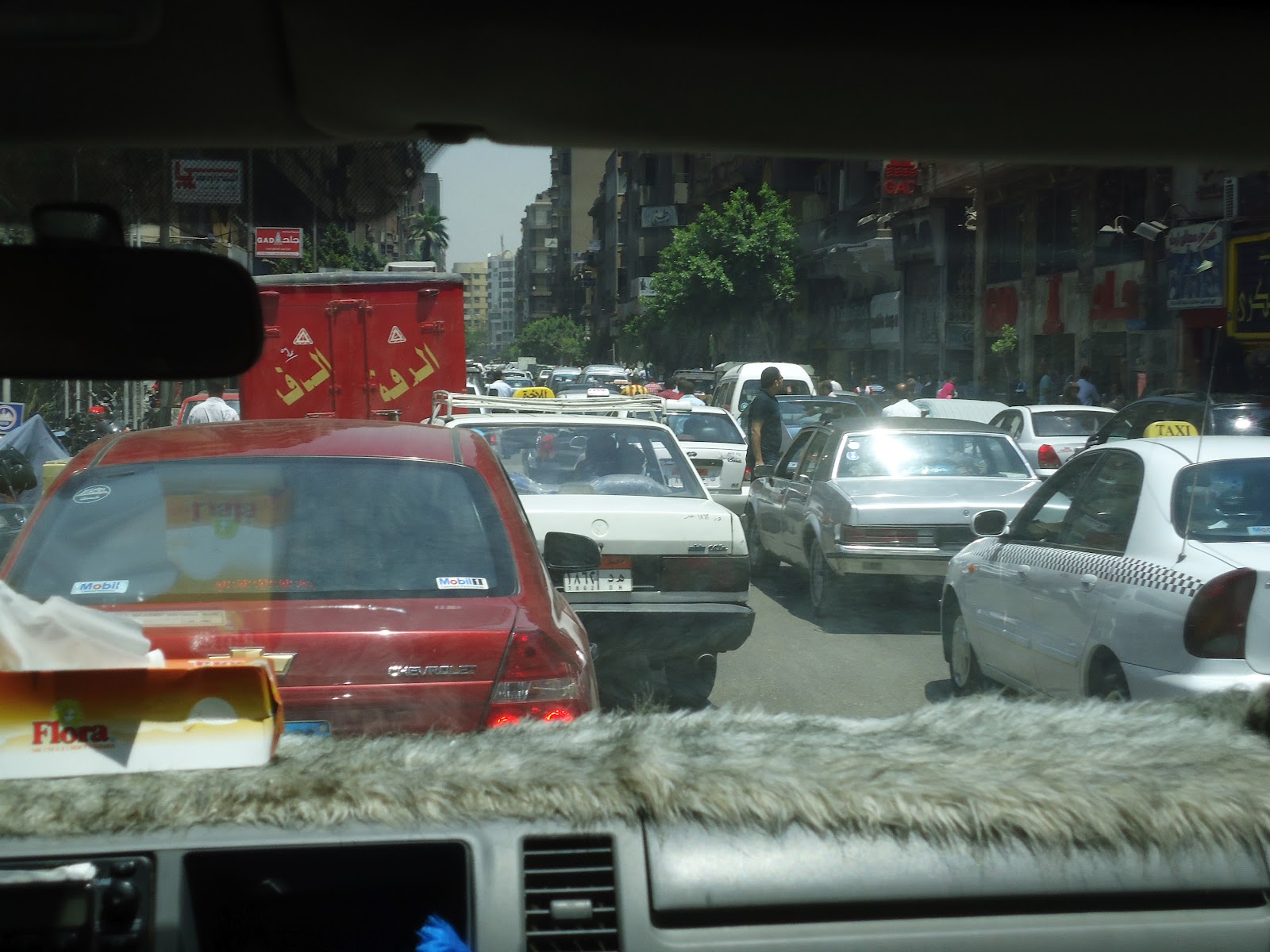
Cairo traffic
 This is what it was like most of the time in Cairo, stopped or crawling traffic. i asked the driver if he got tired of the traffic being so bad and he said this was a good day!

Highway ends in a ditch, outside Giza.
If that looks like 4 lanes of traffic coming towards us, that's because it is. We were crusing along at about 50miles per hour when Sharif had to slam on the brakes because the road construction crew had dug a 3foot-deep, 1foot wide ditch all the way across the street!! There was no sign or anything! So he had to turn around and drive back like 500yards and do a u-turn on to the other side of the divider!

Saqaara Road.

Pyramid Road, Giza.
 That's The Great Pyramid of Giza on the left and The Pyramid of Khufu on the right. Big intersections being controlled by armed traffic cops were nice, but rare.

Giza village street.
 This is the street where Sharif lived. The smallish car seemed huge in these crowded streets. Luckily, there were very few other cars. The bigger traffic problems here were store merchandise in the streets, children playing, and camels!!

"Fucking camel!" 
That's what Sharif said at this moment, with a smile. After he got to know me, he loved to say "Fucking," it really amused him.

Saqaara traffic (or at least i think that's where it was)
 So much heavy traffic! It reminded me of India, though it was not actually THAT chaotic, just almost. The way it worked was, everybody just drove wherever they wanted, and everyone else would shift to help them make it happen. BUT, as soon as anyone else made their move, everyone would shift to letting THEM go, including the other person who had just gone. It seemed to work out remarkably well actually.

Dashur village road

This narrow thing is a two way street. We were coming up behind the lady not too slowly, and the on coming car has just skidded to slow down. i happened to catch it in a moment when he was flashing his lights, indicating that we should all get out of his way!
Egyptian gas price.
i struggled pretty hard figuring out how to do all the math to convert this from liters to gallons and from Egyptian pounds into American dollars. i'd be glad if someone would check it for me, because if i did it right, they're paying $.56 per gallon of Unleaded gas!! Just 56cents!

Egyptian traffic.
We came up behind this truck going a lot faster than it was, so we crossed out into the other lane to pass, which is when we found this three-wheeled tut coming towards as at like 25mph. The craziest thing is, we went left and the tut passed BETWEEN us and and that trucking thundering next to us!!

Pyarmid Road, Giza
The road outside my hotel in Giza was full of fast-moving traffic probably 18hours per day. It was hard to get a night shot to come out, but on the right you can see people jumping out of that van. They would just slow down and let people on or off whenever and where ever they felt like. Caused chaos, drove my drivers batty.


Downtown Cairo at dawn.

My flight out left at 9.30am, so to get there two hours early we had to leave the hotel at 6.30am. In a completely un-Cairo-like way, the streets were empty and we drove straight through downtown to get there.
Related Posts Plugin for WordPress, Blogger...